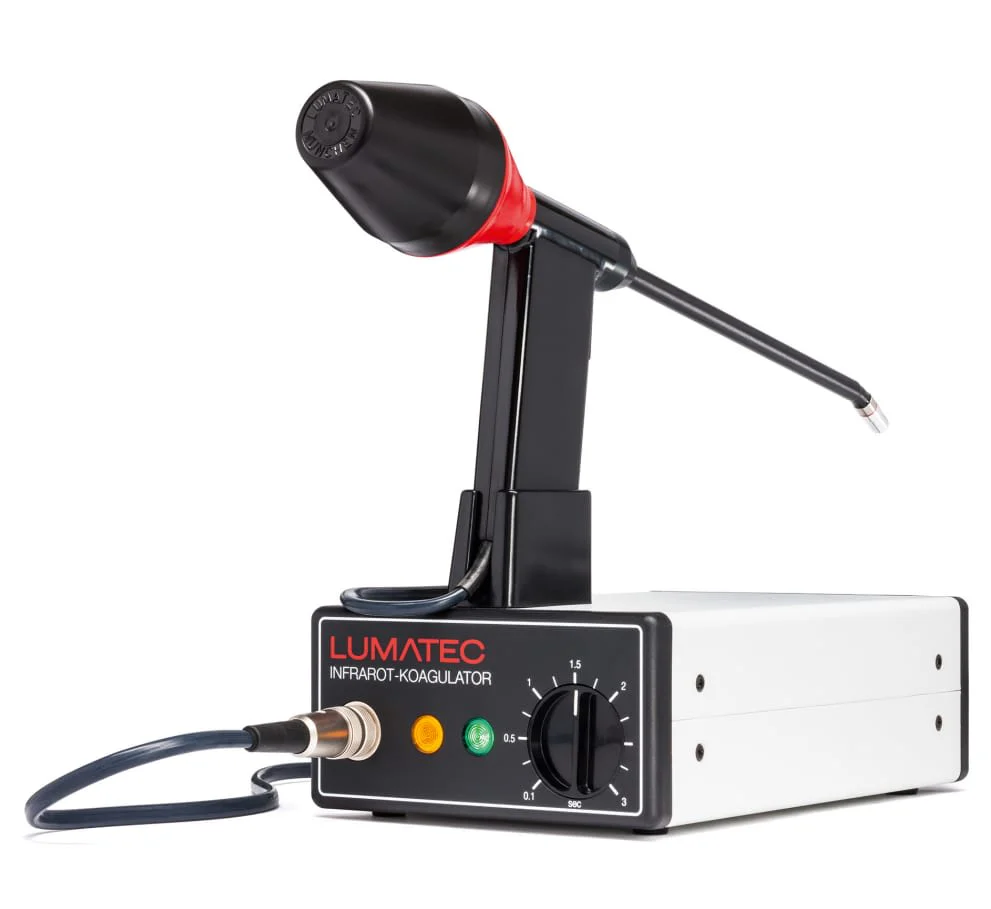
Not every hemorrhoid treatment involves a rubber band, a scalpel, or a lengthy recovery. For early-stage internal hemorrhoids, infrared coagulation — IRC — is a quick, low-discomfort office procedure that most patients find surprisingly manageable.
Want personalized guidance for your symptoms? Talk directly with a board-certified colorectal surgeon.
Book a virtual consult
Infrared coagulation — often called IRC — is a non-surgical procedure that uses infrared light to treat Grade I and Grade II internal hemorrhoids. It's quick, well-tolerated, requires no anesthesia, and has a low risk of side effects. For patients who want a minimally disruptive treatment, it's worth knowing about.
A small probe delivers brief pulses of infrared light to the tissue just above the hemorrhoid. The heat causes the blood vessels feeding the hemorrhoid to coagulate — essentially sealing off the blood supply.
Over the following days and weeks, the coagulated tissue shrinks and scars. That scar helps anchor the tissue, reducing prolapse and cutting off the blood flow that kept the hemorrhoid enlarged.
IRC is done in the office with no preparation required. The procedure takes 5 to 10 minutes. Each application of the infrared probe lasts about one second — most patients feel only a brief sensation of warmth. Because the treatment is applied above the dentate line, pain sensation is minimal.
One to three hemorrhoids can typically be treated in a single session. If follow-up sessions are needed, they're scheduled 3 to 4 weeks apart.
IRC is most effective for Grade I and Grade II internal hemorrhoids — those that are enlarged but either don't prolapse or prolapse only with straining and retract on their own.
It's also a strong choice for patients who are on blood thinners and can't safely stop them, since IRC carries minimal bleeding risk. It works well for patients who've had prior anorectal procedures that created scarring, making other techniques less straightforward.
Both are effective non-surgical treatments for internal hemorrhoids. IRC tends to cause less post-procedure discomfort and has a lower risk profile. Rubber band ligation generally has a higher single-session success rate for Grade II and III hemorrhoids, meaning fewer patients need repeat treatments.
Dr. Chung will recommend the option best suited to your specific hemorrhoid grade, health status, and preferences — and in some cases, a combination of both approaches is used.
Most patients return to normal activities the same day. Some mild pressure or spotting may occur in the days following treatment. Continuing a high-fiber diet and staying well hydrated during healing helps protect the treated tissue and prevents recurrence.
Get expert, personalized guidance from Dr. Albert Chung, a board-certified colorectal surgeon focused on getting you back to comfort, fast.
Call (714) 988-8690Book a virtual consult